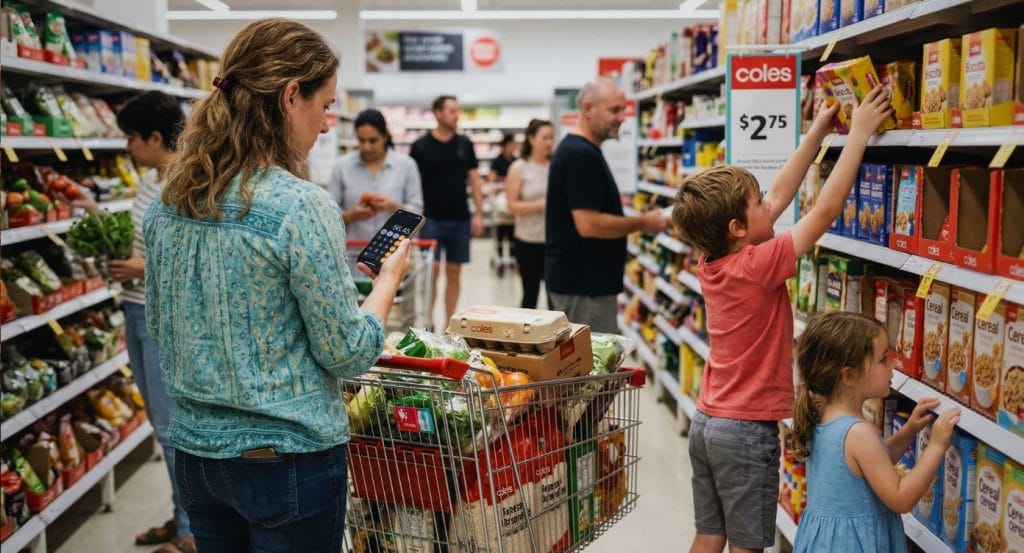
The Checkout Shock Is Real.
If you feel like your grocery trolley keeps getting smaller while the total at the checkout keeps getting bigger, you are not imagining it.
Cost of living pressure is still biting hard in Australia, and groceries are one of the most visible places people feel it. You can skip a new TV. You can put off a weekend away. But food? That one turns up every single week, demanding cash like clockwork.
The tricky bit is that grocery pain is not always dramatic. Sometimes it is obvious – meat costs more, fruit costs more, chocolate costs more. Other times it is sneakier. Pack sizes shrink. Specials are not quite as special. A couple of extra “just grabbing one thing” trips sneak in during the week and suddenly the budget has blown out again.
If you are trying to save money on groceries, the good news is that there are still practical things you can do, even in a high-cost environment.
This guide is here to help you understand what is happening, and more importantly, what you can actually do about it.
What the Data Is Telling Us
The Australian Bureau of Statistics reported that Food and non-alcoholic beverages rose 3.4% in the 12 months to December 2025. Within that, meat and seafood rose 4.4%, fruit and vegetables rose 4.0%, and meals out and takeaway food rose 3.5%. ABS CPI, December 2025
Trading Economics, using ABS data, shows Australian food inflation at 3.1% in January 2026. That is a little softer than December, but still hardly a reason to throw a party in aisle seven. Trading Economics – Australia Food Inflation
Finder reported the average Australian grocery bill at $204 per week in 2025. National Seniors cited research putting average weekly grocery spending at $213.64, with extra spontaneous midweek shops costing many households around $97 a month. Finder – Average Grocery Bill | National Seniors – Save Money With These Shopping Tips
So yes, the squeeze is real. But that does not mean you are powerless, and it does not mean you cannot still save money on groceries with a better system.
12 Smart Facts About Rising Grocery Costs in Australia
1. Grocery inflation is not just “in your head”
A lot of people blame themselves when the grocery budget creeps up. They assume they have gotten sloppy or weak.
Sometimes that is part of it. But the data says prices genuinely have risen. When food inflation is running above 3%, households feel it quickly because groceries are a constant expense, not an occasional one.
2. Fruit, veg and meat can blow out faster than people expect
The ABS figures show some of the biggest pressure points have been areas households buy every week – especially produce and protein.
That is why grocery stress often hits even disciplined shoppers. You can do “the right thing” and still get clipped by higher prices in the healthy basics.
3. Midweek top-up shops are often budget killers
This is one of the sneakiest traps.
People do one main shop, feel pretty good about themselves, then duck back in two or three times for bread, milk, snacks, a few extras, and suddenly the weekly total is nowhere near what they planned.
Research cited by National Seniors says those unplanned extra shops are costing many Aussies about $97 a month. That is real money – the sort that vanishes quietly and then leaves you wondering where it went.
4. Shrinkflation is making comparison harder
One reason people feel like they are spending more for less is that sometimes they literally are.
CHOICE has highlighted shrinkflation examples, including Easter chocolate products where pack sizes got smaller while prices stayed the same or rose, with some consumers effectively paying 31% more per 100g. CHOICE – Easter shrinkflation
The point is broader than Easter eggs. If the pack is smaller, the shelf price alone can fool you.
5. Generic brands are not just for “tight” weeks anymore
The old idea that home brands are only for people doing it tough has gone out the window. Plenty of sensible households now switch between branded and generic depending on value.
That is not small change. Over a year, smart swaps can add up to real money.
6. Shopping at one supermarket for everything is convenient, but not always cheap
Convenience has a price. Sometimes literally.
Not every household wants the hassle of becoming a part-time supermarket detective, but the principle still holds: blind loyalty can cost you.
7. Convenience food often carries a “lazy tax”
Pre-cut, pre-packed, individually portioned, snackable, grab-and-go – all handy, all usually more expensive.
That does not mean you can never buy convenience food. It just means it helps to know you are paying extra for saved time, not better value.
8. Eating at home still matters more than most people admit
Takeaway has become so normal that many households barely count it as a separate category anymore.
But takeaway prices have also risen. If your grocery budget feels high and you are doing takeaway a few times a week, the total food spend can really get away from you.
9. Meal planning is boring – and ridiculously effective
Yes, meal planning sounds like the sort of thing a person with colour-coded lunch containers might bang on about.
Unfortunately, they are often right.
Planning meals cuts down on impulse buys, duplicate purchases and expensive “what’s for dinner?” panic runs.
10. A shopping list still works
Not sexy. Still useful.
One of the simplest ways to reduce overspending is to shop with a list and stick to it. That matters even more when prices are rising and every “treat” or impulse throw-in stings a little more than it used to.
11. You do not need to become a miser to save serious money
This is important. Saving money on groceries does not mean living on plain rice and emotional damage.
It means being more intentional. Choosing your wins. Cutting waste. Being smarter with timing, brands, specials and the number of times you walk into a supermarket each week.
12. Loyalty can cost you if you stop comparing
A lot of shoppers get into autopilot with one supermarket, one set of brands, one routine. That is understandable, but it can get expensive.
Even if you do not want to split your shopping across multiple stores every week, occasionally checking prices on your regular staples can stop you overpaying out of habit.
12 Practical Ways to Save Money on Groceries Every Week
1. Start with a weekly number – not a vague hope
Before you shop, decide what the week’s grocery budget actually is. Not “around two hundred-ish.” A number.
If you do not set the line, the supermarket will set it for you.
2. Do one main shop and make the top-up shop your enemy
Try to structure the week around one proper shop. The fewer extra trips you make, the less chance you have of chucking in random extras you did not plan for.
3. Build your meals around what is already on special
Instead of deciding what you feel like eating and then paying whatever it costs, flip the process around. See what protein, produce and pantry basics are on special, then build the week from there.
4. Check unit pricing, not just sticker price
This is one of the best defences against shrinkflation and dodgy “specials”. Price per 100g, per kilo or per litre tells you far more than the shelf ticket by itself.
5. Use generic brands selectively
You do not need to switch everything. Start with categories where the difference is barely noticeable – pantry staples, cleaning products, frozen veg, bread, canned goods, rice, pasta, paper goods. That is where savings add up fast.
6. Stop buying food twice
One of the biggest leaks in grocery spending is waste. If food is expiring before you use it, you are not just overspending – you are literally binning money.
Before each shop, do a quick fridge, freezer and pantry check.
7. Buy produce seasonally where you can
When fruit and veg are in season, they are often cheaper and better. When they are not, they can get very expensive very quickly.
You do not need to memorise a farming almanac – just be flexible enough to swap what is pricey for what is plentiful.
8. Keep a short list of “default cheap meals”
Every household should have about five low-cost meals it can make without much drama. Pasta, stir-fry, soup, tacos, fried rice, tray bake, whatever works for your crew.
That saves you from the expensive “we’ve got nothing to eat” spiral that usually ends with takeaway or a bloated quick shop.
9. Avoid shopping hungry, rushed or annoyed
This sounds silly until you realise how much damage a bad mood and an empty stomach can do to a trolley.
Hungry shopping is aspirational shopping. Suddenly everyone apparently needs chips, bakery treats, marinated meat and a dessert they have never bought before.
10. Split your list into “must have” and “nice to have”
This is a great way to stay flexible if prices are worse than expected. Your essentials come first. The extras only go in if the budget still has room.
11. Compare supermarkets, but do it sensibly
You do not need to spend half your Saturday driving between five stores to save 83 cents on yoghurt.
But it can be smart to know where your key staples are usually cheapest and to split your shop strategically when the savings justify the effort.
12. Treat grocery savings like a proper win
If you shave $20, $30 or $50 off your weekly grocery spend, that is not “nothing”. Over a year, it becomes real money.
Save that difference, pay down a debt, or use it to create breathing room elsewhere in the budget. The point is to notice the win, not let it disappear into general spending fog.
A Weekly Grocery Reset That Actually Works
If your grocery spending feels out of control, here is a simple reset:
- Set a weekly budget
- Plan 5 to 6 dinners before you shop
- Check what you already have at home
- Shop once properly
- Use unit pricing
- Swap brands where it makes sense
- Avoid the “just grabbing one thing” trip midweek
Do that for a month and you will get a much clearer picture of where your grocery money is really going.
If you are trying to get your whole household budget under better control, this article also pairs nicely with our guide on how to save money over Christmas. Different season, same principle: small savings repeated often matter more than one heroic budget sprint.
And if rising food costs have already pushed your budget off track, our article on recovering from overspending without making it worse can help with the broader reset mindset too.
What If the Budget Is Already Too Tight?
For some households, the issue is not careless spending. The problem is that the numbers are genuinely tight and there is not much wiggle room left.
If that is where you are, the goal is to get sharper with spending first. But if you are under real short-term pressure, take care not to solve a grocery problem by creating a much bigger debt problem. Our Warning About Borrowing page is worth reading before taking on any new credit.
And if you do need to explore finance because of a genuine short-term squeeze, keep it purposeful and realistic. Do not borrow emotionally just because Coles and Woolies have started behaving like luxury retailers.
Final Thoughts
The cost of groceries in Australia is up. That is real. The pressure people feel at the checkout is real too.
But the answer is not despair, and it is not pretending inflation is all in your imagination. It is getting a bit sharper, a bit more deliberate, and a bit less easy to trick by supermarket psychology.
You do not have to shop perfectly. You just need to shop more intentionally than you did last week.
If you want to save money on groceries, that is the real secret – not perfection, just better habits repeated week after week.
And in this economy, that is not being stingy. That is being switched on.
Disclaimer
The information in this article is general in nature and does not take into account your objectives, financial situation or needs. It is not personal advice, tax advice, legal advice or a recommendation to apply for any product. Before acting on any information, you should consider whether it is appropriate for your circumstances and seek independent financial, legal and tax advice where appropriate.
Get A Loan Finance Pty Ltd is not a lender. We work with a panel of lenders and finance providers. Product features, eligibility criteria and availability can change without notice.