You have found the car you want. You have done the sums. But when the lender comes back with your car loan interest rate, it is higher than you expected. Sound familiar?
Here is the thing most car finance sites won’t tell you: the rate advertised on a lender’s website is almost never the rate you will actually get. Those headline numbers are reserved for borrowers with near-perfect profiles. The rate you are offered depends on a mix of personal, vehicle and market factors that lenders weigh up behind the scenes.
Understanding what drives your car loan interest rate is the single best thing you can do before you apply. Not after. Before. Because once you know the levers, you can pull them in your favour. This guide breaks down nine factors that Australian lenders actually assess when setting your rate, and what you can do about each one.
Why Car Loan Interest Rates Vary So Much in Australia
If you have ever compared car finance offers, you have probably noticed that rates can swing wildly from one lender to the next. One bank might quote you a rate several percentage points higher than an online lender, even for the same car and the same loan amount.
That is because car loan interest rates are not one-size-fits-all. Each lender uses its own risk model to assess your application and assign a rate. Some lenders weight your credit score heavily. Others care more about the age of the vehicle or whether you own property. The Reserve Bank of Australia’s cash rate influences the baseline cost of funds for every lender, but from there, each institution adds its own margin based on how risky it thinks your loan is.
According to data from Money.com.au, the average car loan in Australia sits at around $34,282, and Australians collectively borrow roughly $4.9 billion per quarter in fixed-term personal loans for road vehicles. That is a lot of money flowing through a system where even a small difference in rate can cost you thousands over the life of your loan. Understanding what influences your rate is not optional. It is essential.
The 9 Factors That Determine Your Car Loan Interest Rate
1. Your Credit Score
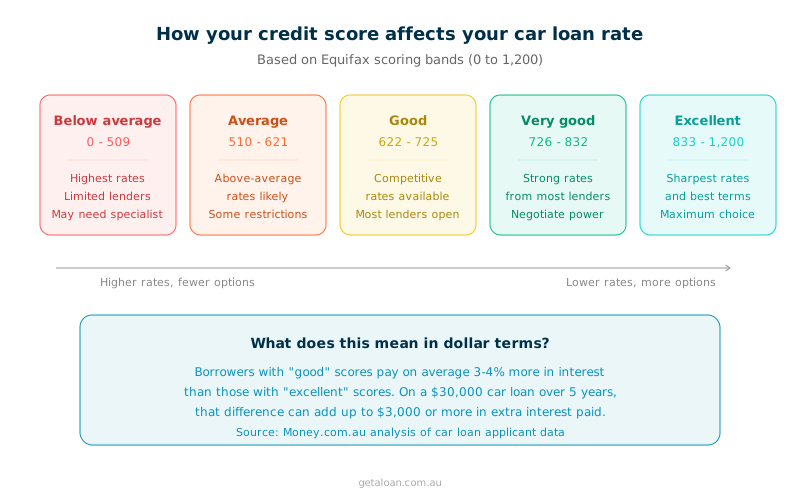
This is the big one. Your credit score is the single most influential factor in the rate a lender will offer you. It is essentially a numerical summary of how reliably you have managed credit in the past. Paid your bills on time? Good. Defaulted on a loan or had a debt sent to collections? That is going to hurt.
In Australia, credit scores typically range from 0 to 1,200 (Equifax) or 0 to 1,000 (Experian / illion), and each provider uses different labels for its bands. If you are not sure how the scoring system works or where your number sits, our guide to credit scores in Australia breaks down the ranges, the providers, and what each band actually means for your borrowing power.
According to Money.com.au’s car loan statistics, nearly half of all car loan applicants (49.43%) had an excellent credit score of 1,026 or above. Those borrowers are the ones landing the sharpest rates. If your score sits below 500, expect to pay significantly more, or potentially face rejection from mainstream lenders altogether.
But here is what many people miss: your credit score is generated from the information sitting in your credit report. That report includes your repayment history, any defaults, the types of credit you hold, and how many enquiries lenders have made. Under Comprehensive Credit Reporting (CCR), your positive repayment behaviour now counts too, not just the negatives. That means months and years of on-time payments actively build your score, which in turn helps you qualify for a better car loan interest rate. If you want to know exactly what lenders are looking at when they pull your file, our article on what shows up on your credit report walks through every item, how long it stays there, and how to challenge anything that looks wrong.
What you can do: Before you apply for car finance, check your credit score for free through services like Credit Savvy or Equifax. If there are errors on your credit report, dispute them immediately. Incorrect defaults or misattributed enquiries can drag your score down unfairly, and getting them removed could shift you into a lower rate bracket. If your score is genuinely low, consider spending three to six months paying all bills on time and reducing existing credit card limits before applying. Even a modest improvement can make a measurable difference. If your credit is already damaged, there are still options. Our bad credit car loans page explains how some lenders assess your current circumstances rather than just your past.
2. Whether Your Loan Is Secured or Unsecured
A secured car loan means the vehicle itself acts as collateral. If you stop making repayments, the lender can repossess the car and sell it to recover their money. Because this reduces the lender’s risk, secured car loans almost always come with lower interest rates than unsecured ones.
An unsecured car loan, on the other hand, does not require any asset as security. The lender has less protection if things go wrong, so they charge a higher rate to compensate. Think of it like this: would you lend money to a mate with no guarantee of getting it back? You would probably want a better deal for yourself, right? That is exactly how lenders think.
As the government’s Moneysmart website explains, most car loans in Australia are secured, and the interest rate difference between secured and unsecured can be substantial. If you are comfortable with the lender having a claim over the vehicle, a secured loan will almost always save you money.
What you can do: Unless you have a specific reason to avoid it (such as buying from a private seller in certain circumstances), opt for a secured car loan. The rate savings over the life of a five-year loan can easily run into thousands of dollars.
3. The Age and Type of Vehicle
The car you are buying matters more than most people realise. Lenders generally offer lower car loan interest rates for newer vehicles, and the reason is straightforward. A new car holds its value better in the early years and is less likely to break down. If you default, the lender can repossess a newer car and sell it for closer to what you owe. An older car depreciates faster and is harder to sell for a decent price.
Many lenders draw a line in the sand at vehicles over seven to ten years old at the end of the loan term. Buy a twelve-year-old car with a five-year loan, and that car will be seventeen by the time you pay it off. Good luck finding a lender happy to secure a loan against a vehicle worth next to nothing by then.
Vehicle type also plays a role. Some lenders offer discounted “green car loan” rates for electric vehicles (EVs) and hybrids, reflecting government incentives and the generally lower running costs of these vehicles. If you are considering an EV, it is worth asking lenders specifically about green car loan rates.
What you can do: If you are flexible on the car, choosing a vehicle that is under five years old will typically get you a better rate. If you are set on an older car, budget for a higher rate and consider a shorter loan term so the car does not outlive the loan.
4. The Loan Amount
The amount you borrow can push your rate in either direction. For lower-risk borrowers, a larger loan amount can sometimes attract a sharper rate because the lender earns more in absolute dollar terms over the life of the loan. It is more profitable for them to service one $50,000 loan than five $10,000 loans.
However, for borrowers who are already on the edge, a larger loan adds more risk. If a lender is already a bit nervous about your profile, asking for a bigger amount can tip the scales toward a higher rate, or a decline.
What you can do: Borrow only what you need. If you can put down a deposit (more on that below), reducing the loan amount gives you a better chance of landing a competitive rate. Also, avoid rolling extras like insurance, extended warranties or accessories into the loan. Every dollar added increases the total interest you pay.
5. Your Deposit
Putting money down upfront does two things for your car loan interest rate. First, it reduces the amount you need to borrow, which directly cuts the total interest you pay. Second, it signals to the lender that you have savings discipline and some skin in the game. Both of those reduce risk in the lender’s eyes.
A deposit also improves your loan-to-value ratio (LVR). If you are borrowing $30,000 for a $40,000 car, the lender knows there is a $10,000 buffer. If you default and they repossess the car, they are more likely to recover the full loan balance even after depreciation.
What you can do: Aim for at least 10 to 20 percent of the vehicle’s purchase price as a deposit. Even a small deposit is better than none. If you are not in a rush, saving for a few months before applying can make a measurable difference to the rate you are offered.
6. Your Employment and Income Stability
Lenders love certainty. A full-time permanent employee with two or more years at the same employer is the gold standard. It tells the lender your income is reliable and you are likely to keep making repayments.
If you are a casual worker, self-employed, a contractor, or you have recently changed jobs, lenders see more uncertainty. That does not mean you cannot get a car loan, but it may mean a higher rate. According to car loan application data, around 88.5% of car loan applicants are employed full-time, which gives that group a statistical advantage.
Self-employed borrowers often need to provide additional documentation like BAS statements or tax returns. Some lenders specialise in self-employed and low-doc car finance, but the rates tend to be higher to reflect the perceived additional risk.
What you can do: If you are planning a career change, try to lock in your car loan first while you are still in stable employment. If you are already self-employed, having at least 12 months of trading history and clean financials will strengthen your application. Avoid applying during a probation period at a new job if you can help it.
7. Whether You Own Property
This one surprises a lot of people. Homeowners tend to get lower car loan interest rates than renters, even though the car loan has nothing to do with the property. The logic from the lender’s perspective is simple: a homeowner has a stable living situation, an asset base, and a demonstrated ability to manage a large financial commitment. All of those reduce perceived risk.
Some lenders are upfront about this. Macquarie Bank, for example, has historically advertised different car loan rates for property owners versus non-property owners. Others factor it in more subtly as part of their overall risk assessment.
What you can do: You cannot buy a house just to get a better car loan rate. But if you do own property (even with a mortgage), make sure the lender knows about it. Some application forms ask, and it can make a genuine difference.
8. The Loan Term
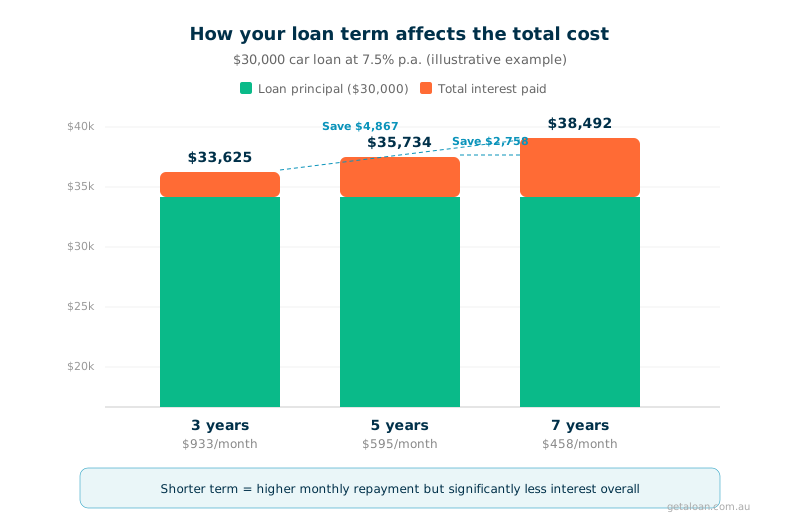
The length of your car loan affects both your monthly repayments and, in many cases, the interest rate itself. Shorter loan terms (two to three years) often attract lower rates because the lender’s money is at risk for less time. Longer terms (five to seven years) spread the repayments out, making each one smaller, but you will pay significantly more interest overall.
There is also a practical element. A seven-year loan on a five-year-old car means the vehicle will be twelve years old when you make your last payment. The car’s value could be well below the remaining loan balance for a good chunk of that term, which is a situation lenders call being “upside down.” That added risk can translate to a higher rate.
To understand the full cost of your loan beyond just the interest rate, it helps to compare using the comparison rate, which bundles in most fees and charges to give you a truer picture.
What you can do: Choose the shortest loan term you can comfortably afford. Even switching from a seven-year term to a five-year term can save thousands in total interest. Use a loan repayment calculator to see the difference before you commit.
9. The RBA Cash Rate and Market Conditions
The Reserve Bank of Australia’s cash rate is the foundation on which all lending rates are built. When the RBA raises the cash rate, it costs lenders more to source funds, and those costs flow through to borrowers. When it cuts, rates can come down (though lenders do not always pass on the full amount).
As of March 2026, the RBA has raised the cash rate to 4.10%, citing renewed inflationary pressures and capacity constraints. This is the second consecutive increase and it has a direct flow-on effect to car loan pricing. Lenders factor in not just the current cash rate, but their expectations of where it is heading. If they expect further increases, they may build that into today’s pricing.
Global events also play a role. Disruptions like the ongoing conflict in the Middle East have pushed up energy costs and added uncertainty to financial markets, which can cause lenders to reprice risk and widen their margins.
What you can do: You cannot control the RBA. But you can time your application strategically. If rates are trending up, locking in a fixed-rate car loan sooner rather than later can protect you from further increases. If rates are trending down, a variable-rate loan might allow you to benefit from future cuts. Keep an eye on the RBA’s meeting schedule and the economic commentary around it.
Practical Checklist: How to Get a Better Car Loan Interest Rate
Now that you know the factors, here is what to do with that knowledge. Before you apply for car finance, work through this list:
- Check your credit score and fix any errors before applying. Even small corrections can shift your rate bracket.
- Save a deposit of at least 10 to 20 percent to reduce the loan amount and improve your loan-to-value ratio.
- Choose a secured loan over an unsecured one wherever possible for a lower rate.
- Keep the loan term as short as you can afford, ideally five years or less.
- Buy a newer vehicle (under five years old) for the best rate options.
- Avoid rolling extras into the loan like insurance, warranties or accessories.
- Compare at least three to four lenders and request personalised quotes, not just advertised rates.
- Use a soft credit check when comparing so your score is not impacted by multiple applications.
- Compare the comparison rate, not just the headline interest rate, to understand the true cost of each loan.
- Get your finance sorted before visiting the dealership so you are negotiating from a position of strength.
What If You Are Already Stuck on a High Rate?
If you are already locked into a car loan with a rate that feels too high, you are not necessarily stuck forever. Here are a few options worth exploring.
First, check whether your loan has an early exit fee. Many car loans now come without one, which means you can refinance to a better deal without penalty. If your credit score has improved since you first took out the loan, or if market rates have come down, refinancing could save you a meaningful amount.
Second, consider making extra repayments if your loan allows it. Even small additional payments can reduce your total interest significantly over the life of the loan. A variable-rate loan typically allows extra repayments without penalty, while some fixed-rate loans restrict this.
Third, if you are genuinely struggling with repayments, do not wait until you miss one. Contact your lender and ask about hardship provisions. Under Australian Consumer Law, lenders are required to consider hardship applications. You can also contact a free financial counsellor through the National Debt Helpline on 1800 007 007. Our warning about borrowing page has additional information if you are feeling the pressure.
Final Thoughts
Your car loan interest rate is not a number plucked out of thin air. It is a calculated assessment of risk based on who you are, what you are buying, and what is happening in the broader economy. The good news is that most of these factors are within your control, or at least within your influence.
The biggest mistake most Aussies make with car finance is accepting the first offer they receive, especially if it comes from the dealership. A few hours of preparation, checking your credit score, saving a deposit, comparing lenders, and understanding the difference between advertised rates and comparison rates, can easily save you thousands over the life of your loan.
If you are ready to see what car loan interest rates you could qualify for, you can compare car loans through our panel of trusted lenders. It takes minutes, there are no upfront fees, and the soft credit check will not impact your score.
Disclaimer
The information in this article is general in nature and does not take into account your objectives, financial situation or needs. It is not personal advice, tax advice, legal advice or a recommendation to apply for any product. Before acting on any information, you should consider whether it is appropriate for your circumstances and seek independent financial, legal and tax advice where appropriate.
Get A Loan Finance Pty Ltd is not a lender. We work with a panel of lenders and finance providers. Product features, eligibility criteria and availability can change without notice.